
I am staying at a campsite in Wapse, in the Dutch province of Drenthe. Today I am heading out by bike to visit Museum and Kamp Westerbork, one of the most important places in the Netherlands for remembering the victims of the Second World War.
This is not my first visit to Kamp Westerbork. After completing the Westerborkpad. It is one of the most important places in the Netherlands for remembering the victims of the Second World War.
Back then, I first walked “just a little further” to the road leading towards Westerbork. And that brings me back to the Westerborkpad itself.

Some long-distance walking trails stay with you because of their beautiful landscapes.
The Westerborkpad is different. When walking this trail, you are not only travelling through the Dutch landscape. You are also walking through an important and deeply moving part of Dutch history.
The Westerborkpad, officially LAW 15, is a long-distance walking trail of approximately 340 kilometres. It runs from the Hollandsche Schouwburg in Amsterdam to the former Kamp Westerbork near Hooghalen in Drenthe.
Much of the route follows the railway line that played an important role in the deportation of Jews from the Netherlands during the Second World War.
Along the way, you pass dozens of places connected to events from the war. Monuments, former transit camps, railway stations and other historical locations each tell part of the story.
You also walk through industrial areas. While walking the Westerborkpad, we sometimes found this quite strange. We often wondered:
Why does this walking route take us through an industrial area?
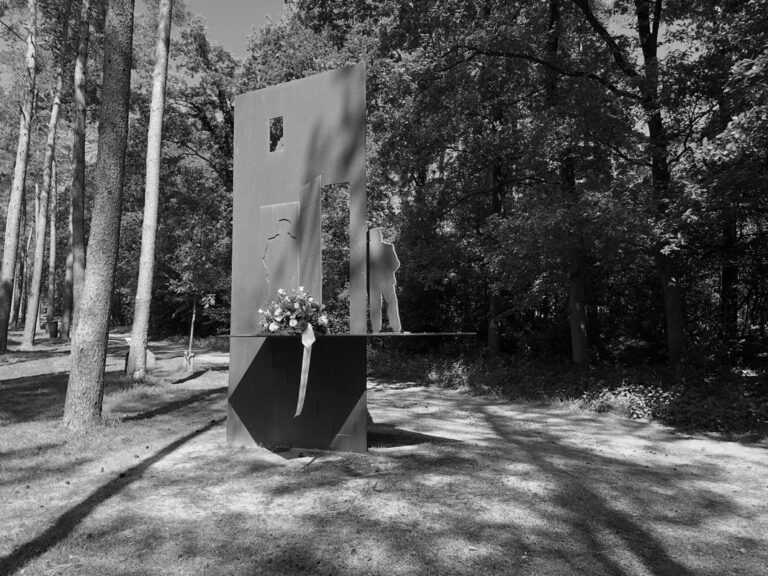
It was only after completing the trail that we discovered the answer. More than 80 years later, it is no longer possible to walk alongside the original railway line everywhere. The Westerborkpad therefore follows the railway as closely as possible. The route never takes you more than approximately five kilometres away from the former railway.
As a result, the trail does not always pass through the most beautiful parts of the Netherlands. But then again…
Beautiful is certainly not a word you would use for what happened here either. Once you understand this, the Westerborkpad becomes much more than an ordinary long-distance walking trail. Of course, you walk through different landscapes and discover new places along the way. But at the same time, the route regularly invites you to stop for a moment.
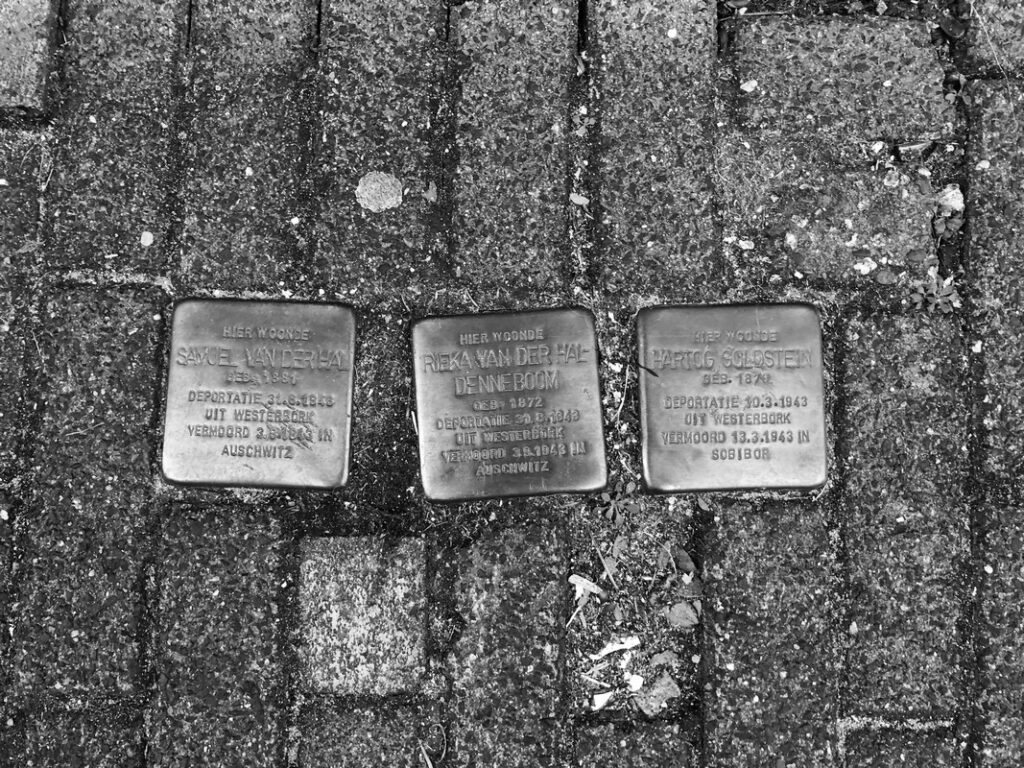
Not only literally, but also to reflect on what happened here and on the people who travelled this route under completely different circumstances. The combination of walking, nature and history makes the Westerborkpad a very special trail.
You can walk the entire route in one journey, but you can of course also divide it into separate stages. Along the way, there are many opportunities to learn more about the history of the places you pass. The Westerborkpad shows that walking can sometimes be about much more than simply covering kilometres.
A walk can make you think. It can help you remember. And it can make you more aware of the past.
That is exactly why this route is such an impressive way to discover part of Dutch wartime history, literally step by step.
A walk that makes you stop and reflect. A route to remember. And above all, a story that we must continue to tell.

There is another important detail about the Westerborkpad. The route is marked in only one direction, unlike many other Dutch LAW long-distance trails, which are marked in both directions. This choice is connected to the history behind the trail.
For the people who travelled this route during the war, going back was also – almost always – impossible. These are the kinds of details you only truly begin to understand when you learn more about the story behind the Westerborkpad.
Read my complete story: The Westerbork Path – A Walk Full of Remembrance and Reflection.
After walking the Westerborkpad, a visit to Museum Kamp Westerbork and the former camp almost feels like an essential part of the experience.
Although I have been here before, I want to visit this place again while I am staying nearby. This time, I want to return alone. Quietly.
When I arrive at the museum, I immediately see the flags and the familiar logo. A large logo on the wall, featuring a piece of barbed wire, makes it clear what this place represents. I park my bike and walk towards the museum.


The museum itself is not large, but its story is enormous.
Inside, you learn about the origins of Kamp Westerbork, how the camp was organised and what it once looked like. There is also a wall displaying the names of those who died. You will recognise some well-known names from Dutch history.
Former Dutch politician Ed van Thijn, for example, arrived at Westerbork as a ten-year-old boy. He survived the war.
Anne Frank was also taken to Westerbork. From here, she was deported to Auschwitz-Birkenau. She later died in Bergen-Belsen.
If you visit the museum, take your time. Walk around two or even three times. Each time, you will notice something you missed before.
On the website of Herinneringscentrum Kamp Westerbork there is a quote that I find incredibly powerful. As far as you can call anything about a place like this beautiful:
“Kamp Westerbork is the story of the murder of one person, repeated 102,000 times.”
That sentence says almost everything.
After visiting the museum, I continue towards the former Kamp Westerbork itself. The former camp is approximately three kilometres from the museum, and I decide to walk there. There is also a bus, but I prefer to go on foot.
Walking quietly along the old railway tracks is both special and confronting. I think about the transports that once departed from this place.
Kamp Westerbork was established in 1939. Before the Second World War, it was built as a refugee camp for Jewish refugees who had fled Nazi Germany.
How cruel that this same place would later become a departure point for deportation transports.
From 1 July 1942 until the liberation in 1945, the camp operated as Polizeiliches Judendurchgangslager Westerbork.
During this period, more than 100,000 Jews, as well as Roma, Sinti and resistance fighters, were deported by train from Westerbork to camps including Auschwitz, Sobibor and Theresienstadt.
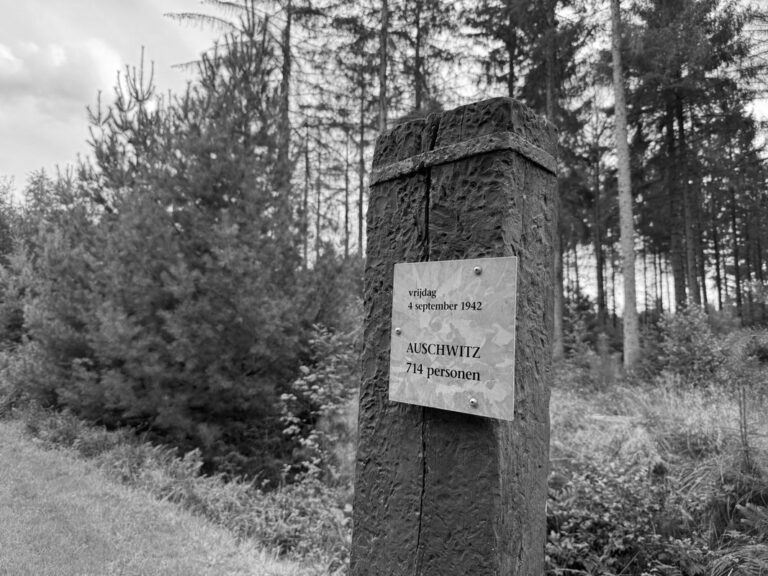
One of the first things you see when entering the former camp grounds is the commandantswoning, the commandant’s house. The house was built in 1939 as the director’s residence for the refugee camp. During the German occupation, its function changed and it became the home of the camp commandant.
During the Second World War, camp commandant Albert Konrad Gemmeker lived here. Over the years, the building gradually deteriorated.
In 2015, a large glass structure was built around it. This protects the house from further deterioration while allowing visitors to see it in its current condition.
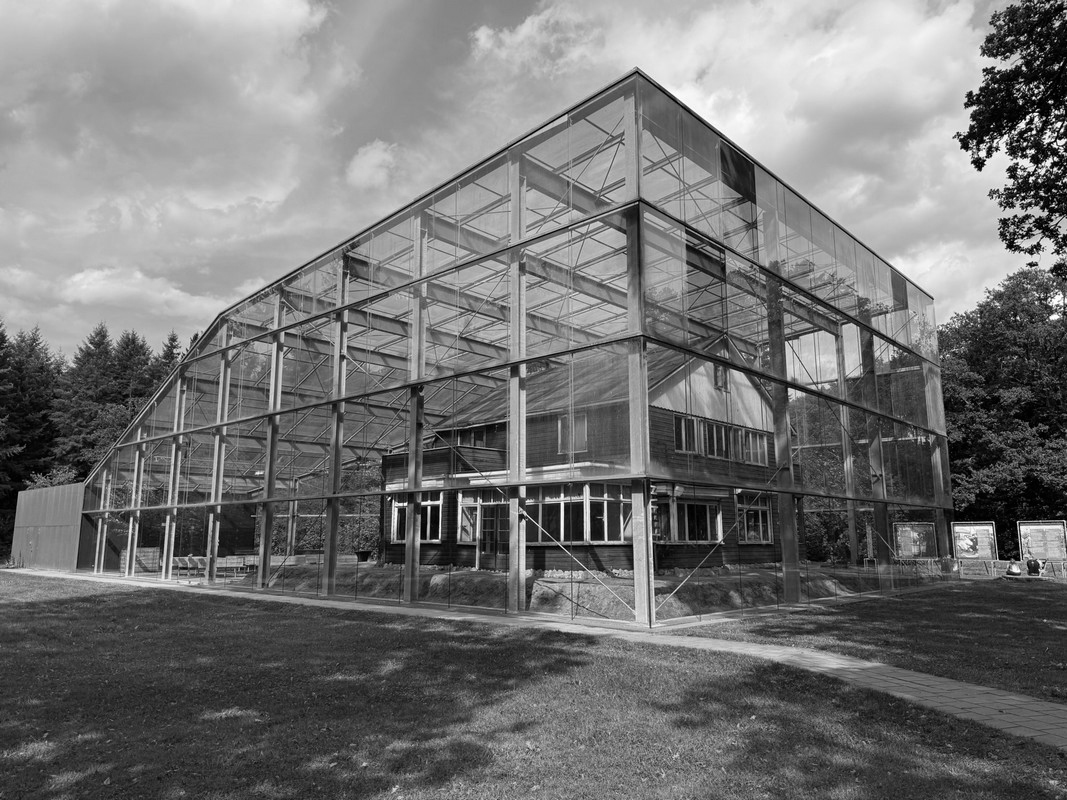


A little further on, you see an old wooden railway wagon. It is a powerful reminder of the trains that transported people away from Westerbork. There were no comfortable seats and certainly no room to travel in any humane way. People were transported in overcrowded wagons, with far too many people in far too little space.
Standing here, it is difficult to imagine that human beings were taken away like this.
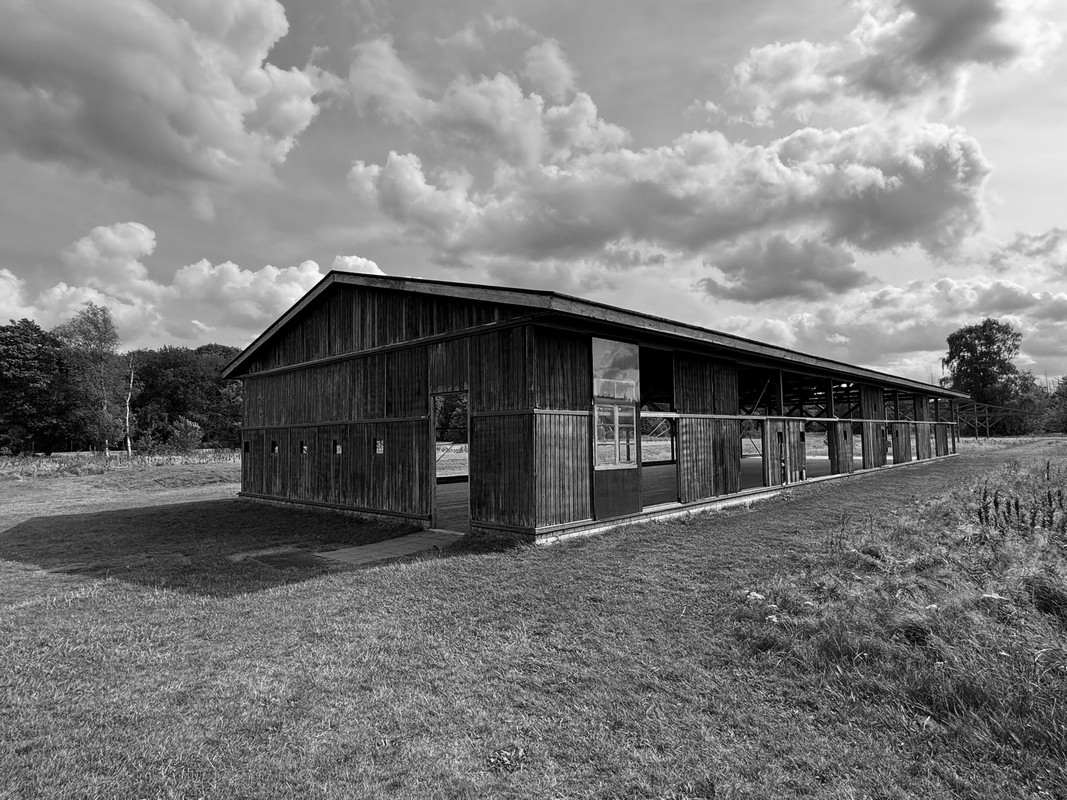
Passing a former barrack, I continue towards one of the most recognisable monuments at Kamp Westerbork: the railway tracks that curve upwards into the air. Nearby you can see barbed wire and a watchtower, reminders of the security surrounding the camp.
The railway monument is a Dutch national monument and was unveiled in 1970 by Queen Juliana. The railway line rests on 93 fixed sleepers. They represent the train transports that departed from Kamp Westerbork. Four additional loose sleepers refer to transports from other locations.
At the end of the tracks is a buffer stop, painted red as a warning against fascism and discrimination. It is one of those places where you automatically become quiet.


Then I walk towards the former roll-call area.
Here you find one of the most impressive memorials at Kamp Westerbork: 102,000 stones, arranged in the shape of the Netherlands. Each stone represents a victim. Most of the stones have a Star of David on top and represent Jewish victims.
There are also 213 stones marked with a flame, commemorating the Sinti and Roma who were murdered. A small number of stones have no symbol. These represent resistance fighters who were deported from Westerbork and did not survive.
I walk between the stones and try to understand what these numbers actually mean.
102,000 people.
102,000 lives.
102,000 stories.
And yet, when written down, 102,000 remains just a number. Perhaps that is exactly why standing here is so powerful. Here, you can see how many individual lives are hidden behind that one number. I take my time and simply allow the place to sink in.
After all these reminders of the past, I walk back through the surrounding countryside. Along the way, I pass the 14 radio telescopes that have become such a striking feature of the landscape around Kamp Westerbork. It is an unusual combination.
Nature. Silence. Science. And memories of a past that can still be felt here. After returning home, I decide to learn more about the history of Kamp Westerbork.
Because what actually happened to the camp after the Netherlands was liberated?
However, the history of Kamp Westerbork did not end with the liberation in 1945. In the decades that followed, the site was used for several different purposes. Each period added another chapter to the history of Westerbork.
Interneringskamp (1945–1948)
Shortly after the liberation, the former camp was used by the Dutch authorities as an interneringskamp.
Members of the NSB, collaborators and former SS members were held here under military guard. They were suspected of treason and were awaiting legal proceedings.
During the war, this place had been the departure point for thousands of deported people. Now it had suddenly been given a completely different purpose.

A few years later, in 1951, the site changed again.
The remaining barracks were converted into Woonoord Schattenberg, where thousands of Moluccan former KNIL soldiers and their families were housed. What had once been a transit camp became home to many families for years.
Schattenberg gradually developed into a small community, with its own school, church and shops. Daily life took place in and around the former camp barracks. Around 1971, this chapter came to an end. The last Moluccan families left and many of the remaining barracks were demolished.
From former camp to a place of remembrance
Afterwards, much of the former camp was dismantled and nature gradually reclaimed the site. But the history of Westerbork could not simply disappear. Over time, awareness grew that what had happened here needed to be preserved, remembered and passed on to future generations.
The site was given a new purpose.
No longer as a camp or residential settlement, but as a place of remembrance.
Here, the different chapters of its history could be preserved and told.
Today, monuments, reconstructions and the historic railway remind visitors of the past. Other visible remains can still be found on and around the former camp grounds.
Together, they tell the stories of the people who once stayed here and the events that took place.
When you walk around Kamp Westerbork today, you are not only visiting a historical location connected to the Second World War.
You also discover what happened to the site and its residents after the war. These different chapters are part of what makes the history of Westerbork so complex and moving. And perhaps that is exactly why I wanted to return, even though I had already been here before.
Not simply to look.
Not just to learn.
But to stop for a moment.
To remember.
Before leaving Herinneringscentrum Kamp Westerbork, there is one final memorial that I want to stop at. Near the entrance stands the Knopenmonument, the Button Memorial.
Large containers are filled with 1.5 million buttons. Each individual button represents one of the 1.5 million Jewish, Roma and Sinti children who were murdered during the Holocaust.
Just think about that for a moment.
1.5 million children.
1.5 million buttons.
1.5 million individual lives.
Earlier, at the former camp grounds, I stood among the 102,000 stones and tried to comprehend the number of lives they represent. And here, at the end of my visit, I find myself doing exactly the same thing again. Looking at a number that is almost impossible to understand.
Until you realise that every single button represents one child.
One life.
One story.
Perhaps that is what places like Kamp Westerbork ultimately ask of us: not only to remember the numbers, but to remember the people behind them.

Location: Hooghalen, Drenthe, the Netherlands
Museum: Herinneringscentrum Kamp Westerbork
Museum and former camp grounds: The former camp grounds are located approximately 3 kilometres from the museum. You can walk there, or use the shuttle bus when available.
My tip: If you are able to, walk from the museum to the former camp grounds. For me, that quiet walk is part of the experience. It gives you time to reflect on the history of the place before arriving at Kamp Westerbork.
Take your time: Allow several hours if you want to visit both the museum and the former camp grounds. This is not a place to rush through.
Walking the Westerborkpad: Kamp Westerbork is also the final destination of the Westerborkpad (LAW 15), a long-distance walking trail of approximately 340 kilometres from the Hollandsche Schouwburg in Amsterdam to Kamp Westerbork.
Plan your visit: Before travelling to Kamp Westerbork, check the official website of Herinneringscentrum Kamp Westerbork for current opening hours, admission prices, accessibility and shuttle bus information.
I walked the complete Westerborkpad myself and wrote a separate blog about the route, its history and my experiences along the way.
Read more: The Westerbork Path – A Walk Full of Remembrance and Reflection
A note about the photography
Many of the photographs in this blog are shown in black and white. I made this choice deliberately, out of respect for the history of Kamp Westerbork and the impact of the stories connected to this place.
For me, black and white reflects the atmosphere of the visit and allows the images to speak without distraction.