
There is a memorial on the Ginkelse Heide that I have seen in photographs many times: Vensters op het Verleden, or Windows on the Past.
I have wanted to see it for myself for ages. So when I look for a walk near Dropzone Ede during my walking week based in Oosterbeek, I know immediately: this is the one.
The Airborne walk is about eight kilometres long and consists of two loops. The route passes places that recall the Second World War. The airborne landings during Operation Market Garden play a major part in the story, but Operation Pegasus also comes up along the way.
I expect a walk filled with history and heathland. What I do not expect is to end the day standing with my face turned towards the sky, watching a whole line of military aircraft fly overhead.
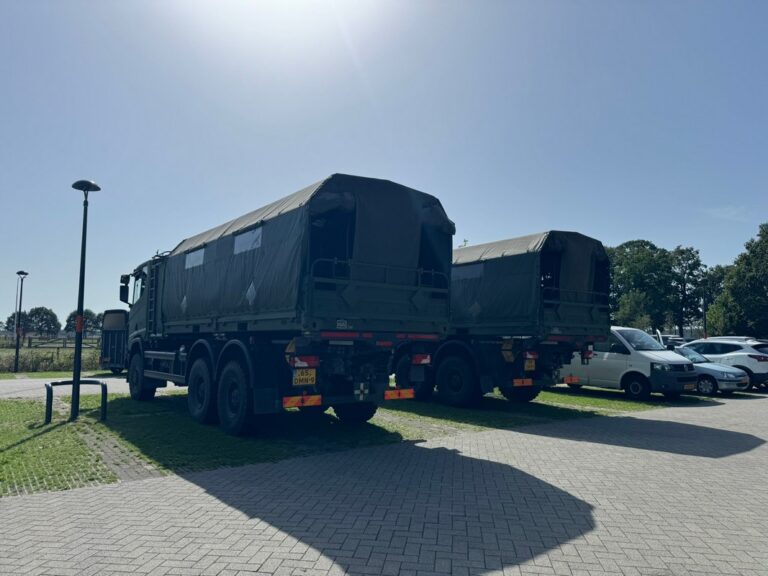
When I arrive at the car park on the Ginkelse Heide, I see three large military trucks. The heath is also used as a military training area, so their presence is not really surprising.
Still, they catch my attention straight away.
My son serves in the army and gets to drive one of those huge machines too. Whenever I see vehicles like these, I cannot help feeling like a proud mum.
I set off on the first loop. It is the first Monday of the month.
And what do I hear? The monthly siren test.
Normally, I hardly give it a second thought. But now I am walking through a place while reading about the Second World War, airborne landings and attacks from the air. Suddenly, that sound feels different.
It makes me quiet. Of course, walking alone is already quiet in its own way. But at that moment, I notice myself turning even further inward. The surroundings, the stories and the knowledge that so much happened here all affect me.
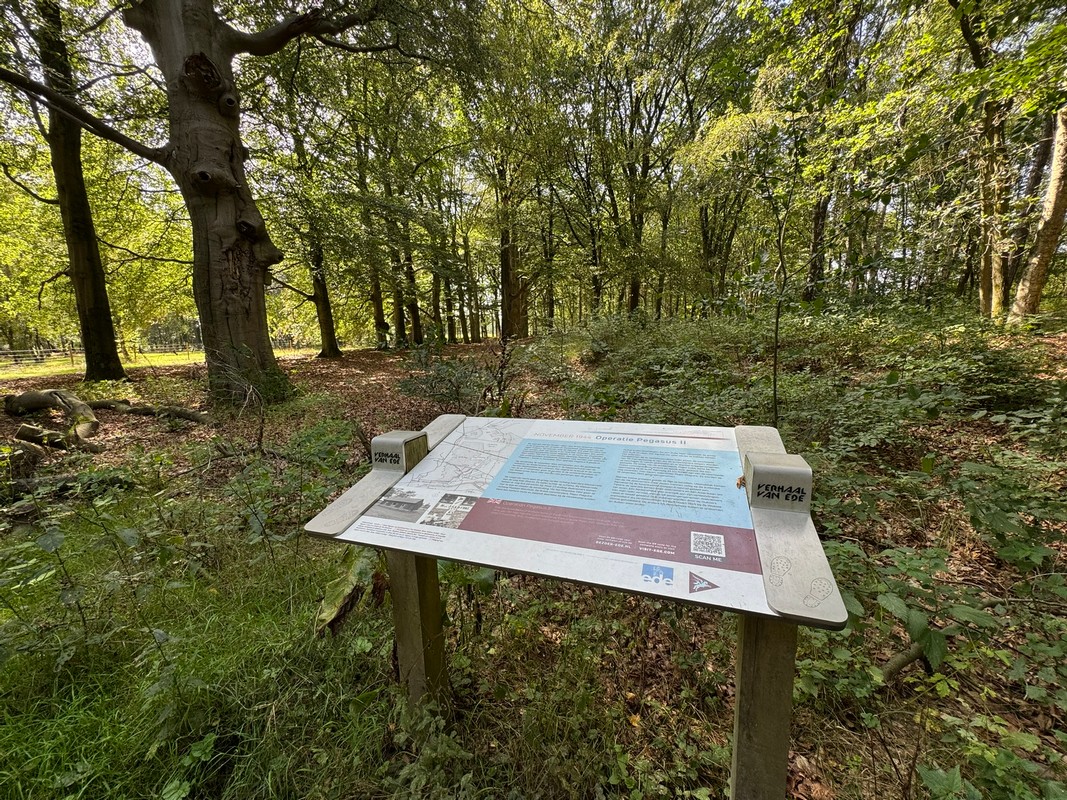
To be honest, I find the first part of the route a little dull. There is not much information along the way, and as a walker I do not see many obvious places of remembrance. Later, I read that several locations here do recall events from the war. You just do not always notice them when you are walking past.
Perhaps that is one of the remarkable things about a landscape like this. You see heath, trees and sandy paths, while so many stories lie beneath that peaceful scene. One of those stories is Operation Pegasus. After the Battle of Arnhem, many British soldiers were left behind German lines. In October 1944, soldiers were helped across the Rhine to liberated territory. The area around the Ginkelse Heide also has a place in the history of that period.
It is remarkable to think how many different stories unfolded around this heath.
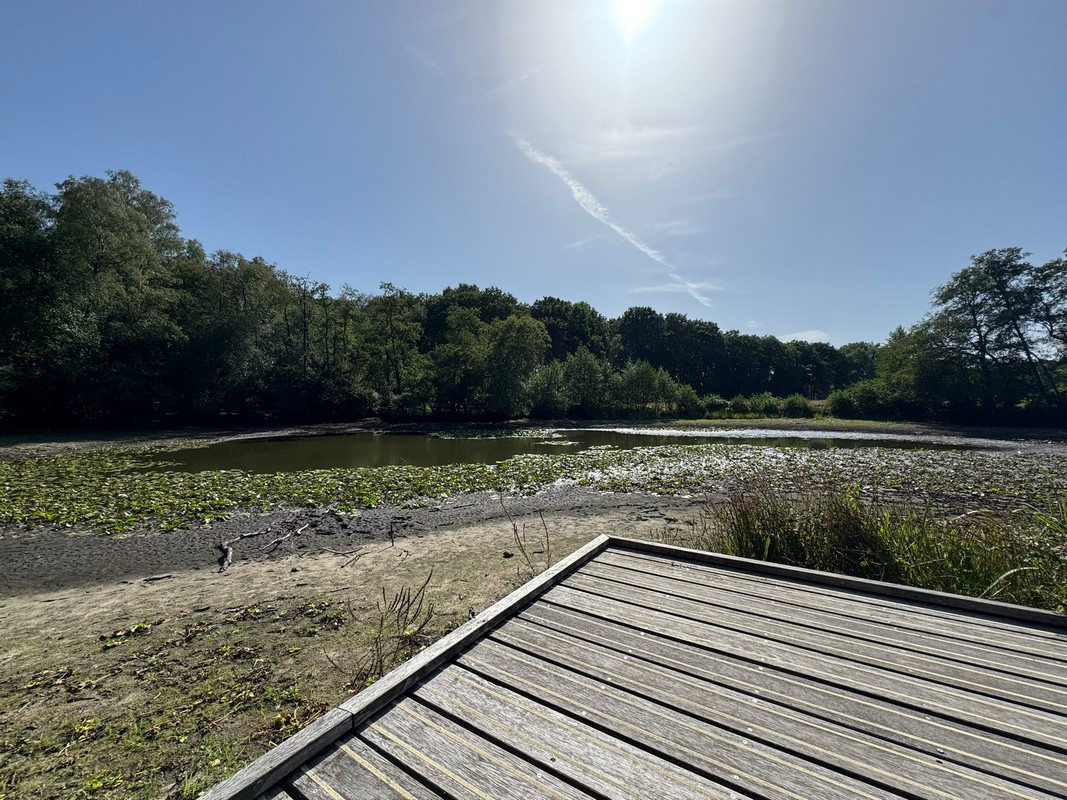
What I do notice straight away is a boardwalk leading to the Heidebloemplas. Of course I have to follow it. The pool is very dry after the warm, dry summer of 2026. The water lilies look a little lost.
Such a shame.
Water lilies are among my favourite flowers. I can imagine how lovely this place must be when there is plenty of water and the flowers are in bloom. I hope, for this place too, that a good downpour comes soon. Preferably at night.
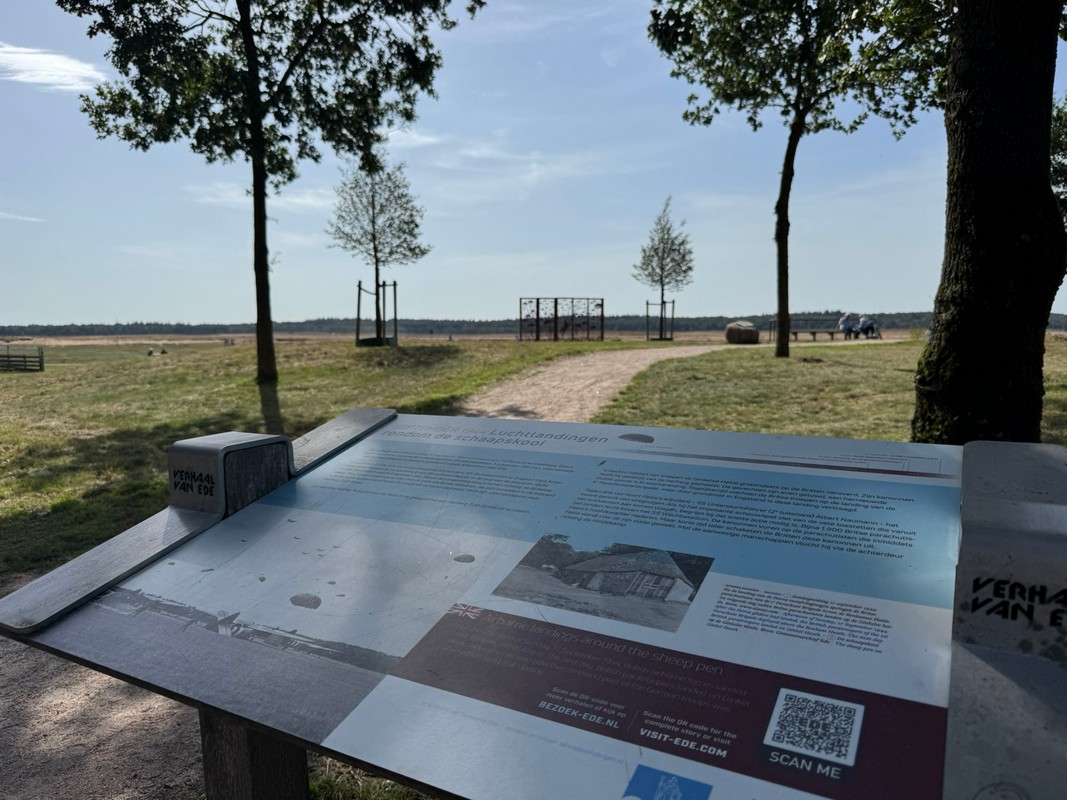
Not far from the Heidebloemplas is a sheepfold. To me, it fits the Ginkelse Heide perfectly. Heathland, sheep and that enormous open space somehow belong together.
But here, too, the landscape has its own history. The area around the sheepfold was used differently in the past. Grazing and changes in land use led to drifting sand. Later, trees and rows of vegetation were planted to help hold the sand in place.
I always enjoy discovering on a walk that a landscape is not nearly as self-evident as it looks. What you see today is the result of many years of human activity and changes in nature.
The training area is accessible today. Apparently, there is not much military activity at the moment, so I can step away from the route for a little while to look at the flowering heath.
I think a break with a view like that is perfectly justified. Afterwards, I walk back to the car park. I cross over and begin the second loop.
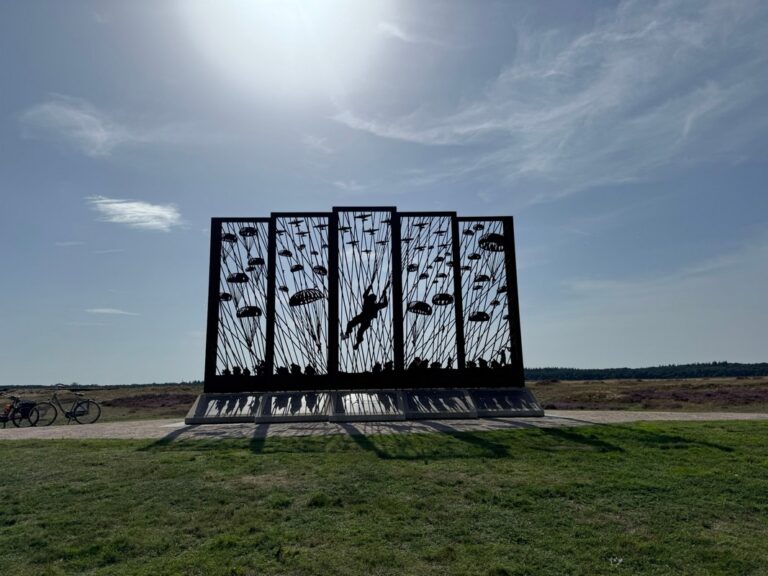
And there it is, almost immediately: the memorial Vensters op het Verleden.
This is the artwork I have seen in photographs so many times. And now I am finally standing in front of it myself.
The memorial recalls the Airborne landings on the Ginkelse Heide during Operation Market Garden. At its base, there is information about the Battle of Arnhem. I take my time reading it all and looking around.
Because it remains extraordinary to stand here and realise what happened on this very spot. In September 1944, thousands of Allied paratroopers landed here. What is now a peaceful natural area was once a place where aircraft came and went, and people and supplies descended from the sky.
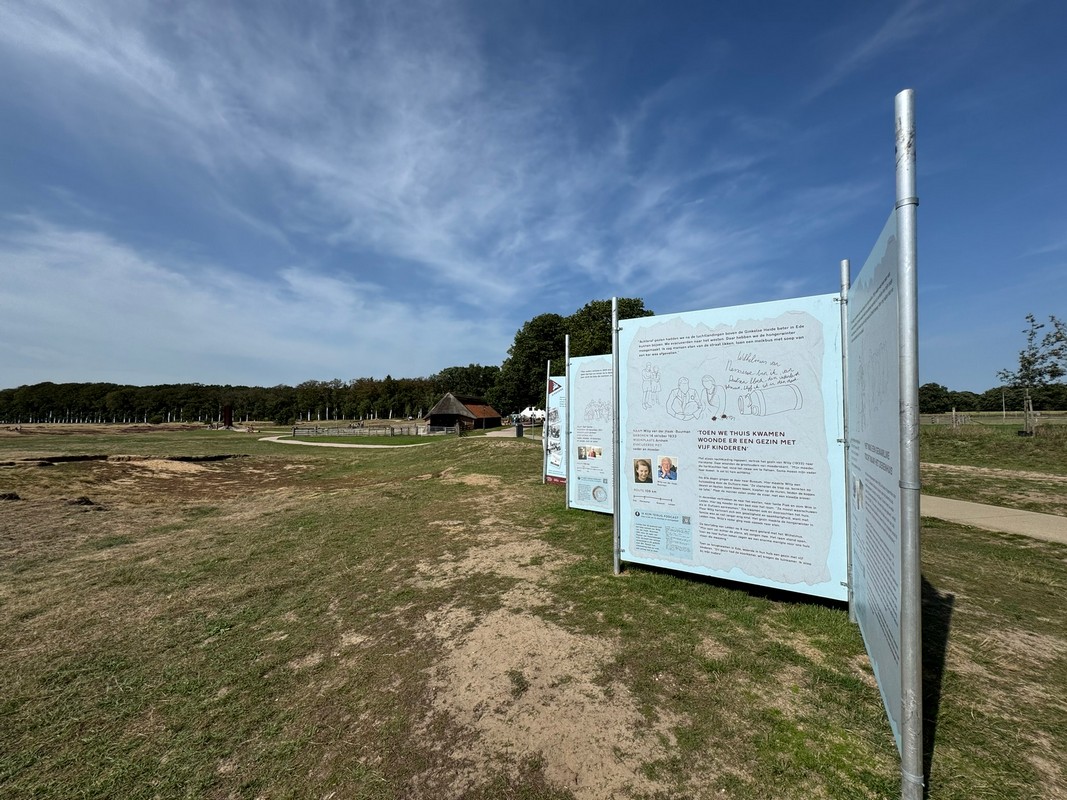
I continue along the cycle path. Beside it are panels telling the stories of resistance fighters who did not survive the war. They remind me of the walk I took in 2025 from the museum to Camp Westerbork. There, too, walking brought me face to face again and again with the stories of people who did not survive.
Those kinds of walks stay with me.
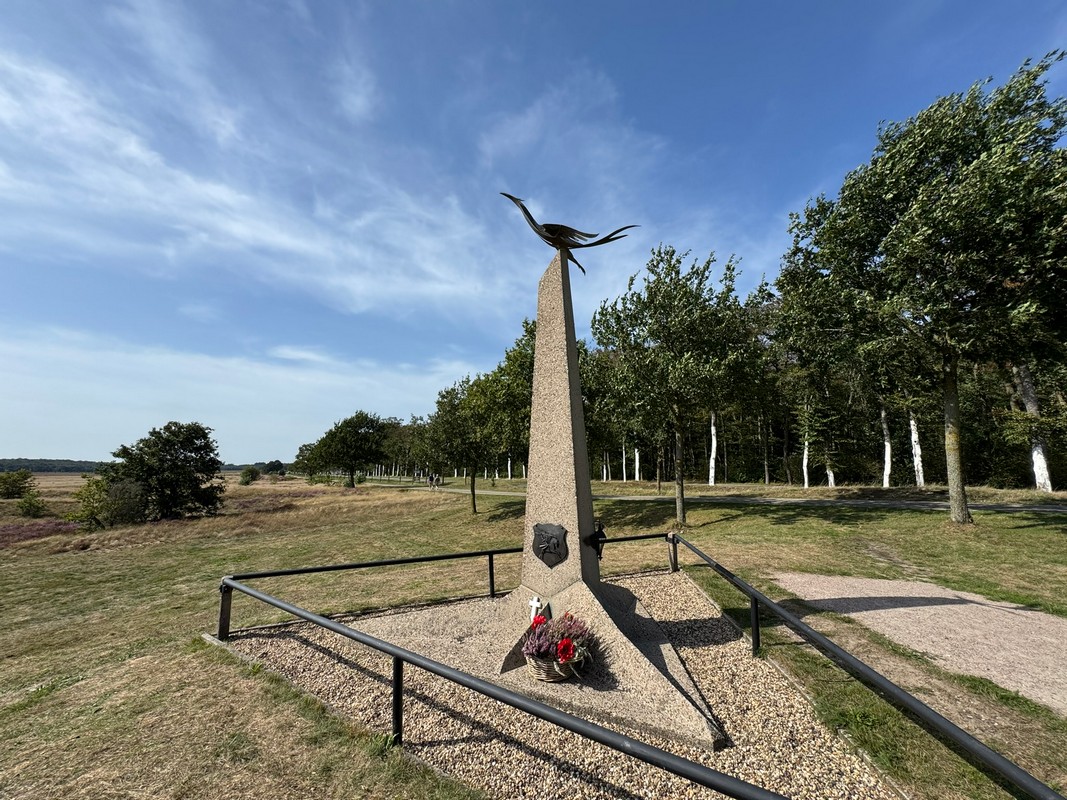
At a point where I need to turn left, I suddenly hear a rustling among the leaves. I look over and see something small dart away.
I have no idea what it is. But for some reason I think: that is not something I see every day. So I investigate.
After looking carefully, I spot a small lizard. Or at least something that looks very much like one. Recently, I have spent quite a bit of time in warm countries where you see them regularly. But in the Netherlands, an encounter like this still feels special to me.
For a moment, I am not thinking about what happened here in the past.
I am simply looking at what lives here now.
That is beautiful too.
I walk on beside the heath. The car park is almost back in sight when I suddenly hear a tremendous noise overhead.
Aircraft.
I look up and see large military planes flying low above me. They are fairly close together and make an incredible amount of noise.
Impressive.
When they have passed, I think that must be the end of it. But a little later, another whole line appears. I count eight aircraft flying one after another.
By now I am close to the car park and can see other people standing there. Almost everyone is looking up.
Just like me.
We are all watching the same spectacle in the sky.
Eventually, I get into my car. Just as I am about to leave the car park, I see more aircraft. Or perhaps they are the same ones returning; I have no idea. This time, they seem to be flying even lower.
For a moment, it almost looks as though they are about to land. Or even crash. Of course, they do not. But it is an impressive sight.
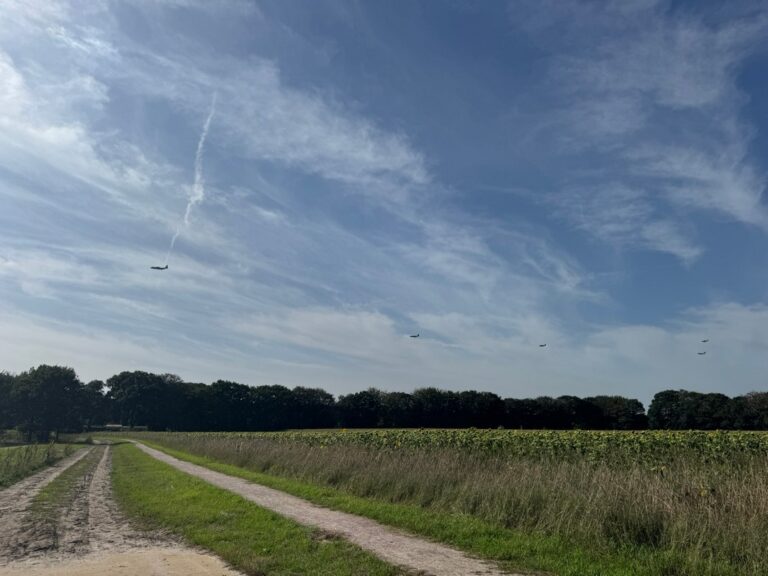
Because this is not something you see here every day, I look up what is happening. Then everything falls into place: an international military exercise called Falcon Leap is taking place. Military personnel are practising airborne operations, including dropping paratroopers and cargo from transport aircraft.
And suddenly I realise just how remarkable my timing is.
I am walking an Airborne route across a historic drop zone. Paratroopers descended from aircraft onto this land in 1944. And during my walk, large military transport planes are flying overhead once again.
Of course, you cannot compare today’s exercise with what happened here during the war.
But seeing aircraft above this place still moves me. For a moment, past and present come together in a very literal way.
Falcon Leap concludes with commemorative parachute jumps over the Ginkelse Heide. I imagine it must be incredibly moving to witness that one day. I will no longer be here when it happens this time, but who knows? Perhaps I will return.
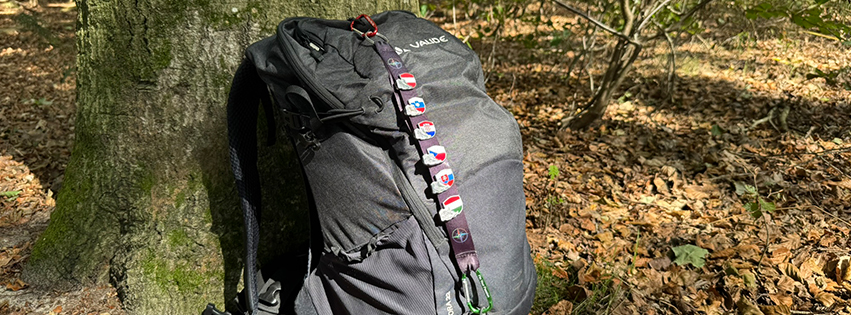
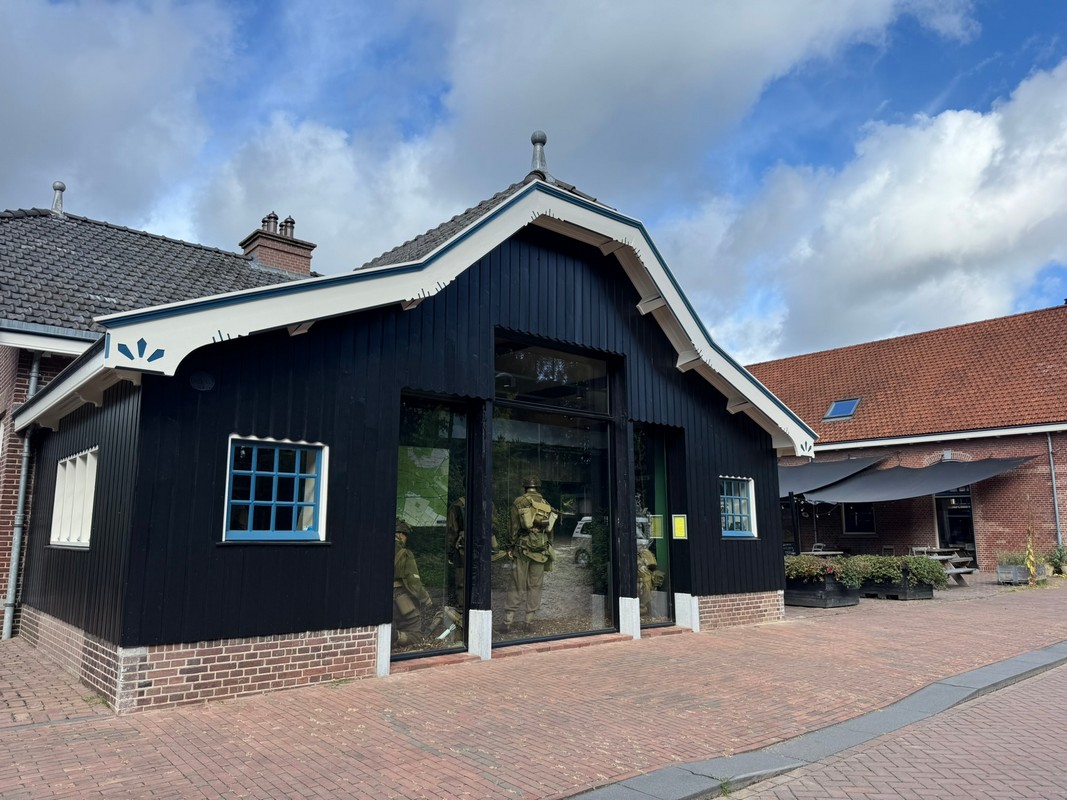
Since I am already in Ede, I decide to visit the Oorlogs- en Garnizoensmuseum Ede, the War and Garrison Museum. It is a small museum with limited opening hours, so if you would like to visit, check when it is open before you go.
The museum is housed in a former military smithy. The man who welcomes me speaks enthusiastically about the building and Ede’s military history. He tells me that many horses once worked here for the military. It immediately makes me see the place differently. It is not just the objects in the museum that have a story; the building itself is part of it too.
At this museum, someone is happy to walk around with you and explain what you are seeing. Upstairs, where the weapons are displayed, you do not explore on your own anyway. A volunteer guides me, and his passion for the museum is obvious.
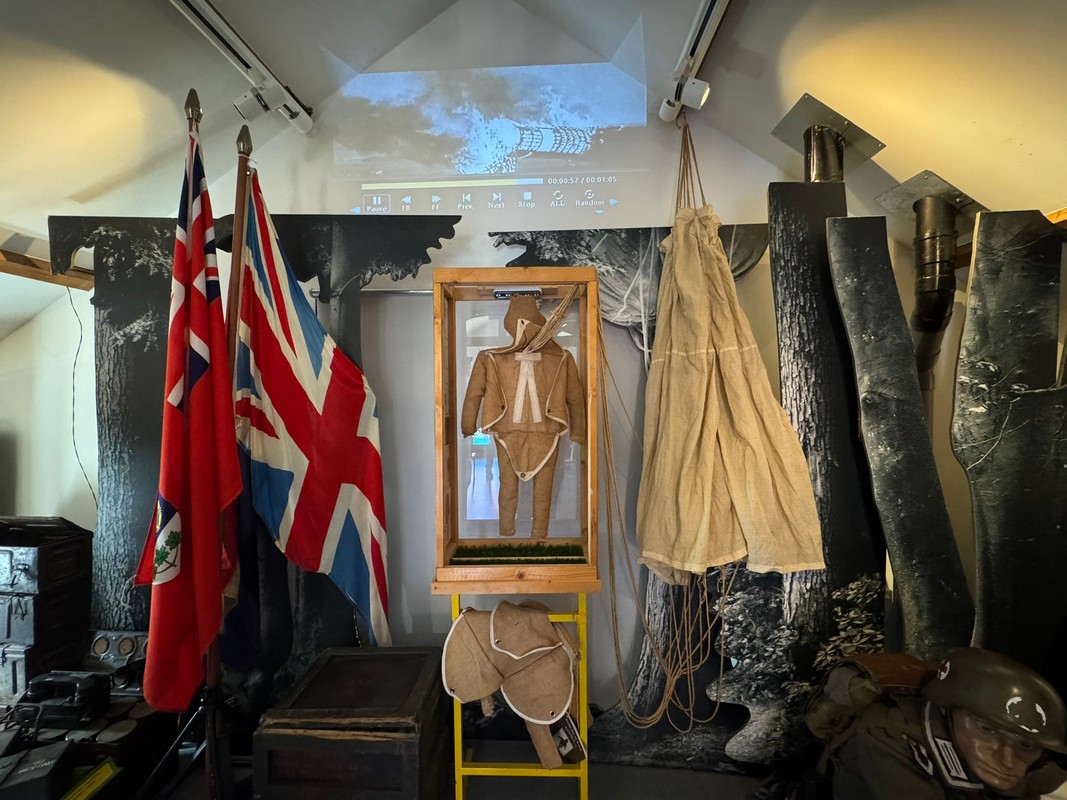
He shows me uniforms. I get to feel how heavy a rifle is. Then I notice a parachute with a small figure hanging beneath it.
I ask what it is.
The volunteer tells me that it is a dummy parachutist, a figure used as a diversion during the war. He calls it a Rupert. The nickname refers to the British comic character Rupert Bear, known in the Netherlands as Bruintje Beer.
What a wonderful story. I had never heard it before.
After more fascinating explanations, I leave the museum with a smile. You can learn so much when you take the time to listen and look properly.
I started this walk because I finally wanted to see the memorial I had looked at in photographs so many times.
And end the day with military aircraft above my head, flowering heath around me, a little lizard among the leaves and stories from a museum that I will not soon forget.
Most of all, I leave with the feeling that the Ginkelse Heide has much more to tell than you might notice at first glance.
This place remembers the past. But the heath is very much alive today as well.
Perhaps it is precisely that combination that made the Airborne walk at Dropzone Ede so special to me.
Where is this walk?
On and around the Ginkelse Heide near Ede in the Netherlands, at the historic Dropzone Ede.
How long is the walk?
The Airborne walk I followed is approximately eight kilometres and consists of two loops. Check your chosen route description before setting off.
What will you see?
Heathland, the Heidebloemplas, a sheepfold, the Vensters op het Verleden memorial and places connected to the history of the Second World War.
Can I always walk through the area?
The Ginkelse Heide is also used for military exercises. Check current access information and follow signs or closures on site.
Can I combine the walk with a museum visit?
Yes. I visited the War and Garrison Museum in Ede afterwards. Check its current opening hours before travelling.
Why is the Ginkelse Heide important to Airborne history?
Allied paratroopers landed on the Ginkelse Heide in September 1944 during Operation Market Garden. Today, the landscape and its memorials help visitors remember those events.
Do I need to walk both loops?
The route I walked consists of two loops starting near the car park. If you are using a published route, follow its directions to see how the loops connect and whether either can be walked separately.
Will I see military aircraft during the walk?
I happened to see aircraft during Falcon Leap, a military exercise. That was an unexpected part of my visit, not something you should expect on an ordinary walking day.
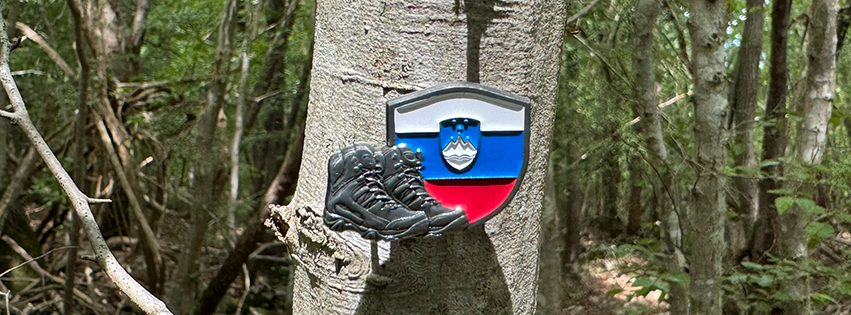
Location: Ginkelse Heide, near Ede, the Netherlands.
Starting point: The car park near the Vensters op het Verleden memorial. Check the route for the exact location.
Distance: Approximately eight kilometres, divided into two loops.
What you will see: The Airborne memorial, heathland, the Heidebloemplas, a sheepfold and places connected to the Second World War.
My tip: Take time to read the information panels. Their stories give the landscape a different meaning.
Museum visit: Combine your walk with the War and Garrison Museum in Ede. Check its limited opening hours beforehand.
Good to know: The heath is also a military training area. Follow marked paths and respect closures.
Komoot / GPS route: Find the Komoot route and GPS information here.